


I tried Singa as a way to turn ordinary spare time into a karaoke session, and my overall impression is simple: it is more useful than a basic lyric screen, but it is not the best choice for someone who wants unlimited singing without thinking about access limits or purchases. The app sits in the music and audio category, and its main appeal is convenience. You can open it when you want to sing, browse for something familiar, and use the phone as a compact karaoke setup rather than preparing a whole evening around it.
That convenience matters more than it sounds. Karaoke apps are often judged by the size of their song collections, but the real test is whether I can find a suitable track quickly, read the words comfortably, and keep the session moving. Singa is designed around that kind of casual use. I see it as a companion for solo practice, a relaxed gathering with friends, or those moments when I want music to be an activity instead of background noise.
The app is free to install, with optional purchases ranging from under a dollar to considerably more for individual items. It also promotes a free trial lasting thirty days, which gives new users a practical way to test the experience before deciding whether it deserves regular use. That trial is important because the value depends heavily on how often you sing and whether the available selection matches your taste.
How Singa feels in everyday use
A straightforward route from browsing to singing
My favorite part of the experience is the short distance between opening the app and actually performing a song. I do not want to spend ten minutes configuring a karaoke system when I only have time for a few tracks. Singa makes more sense in that situation than a collection of videos scattered across a general video platform, where results can vary in quality and the lyrics may be difficult to follow.
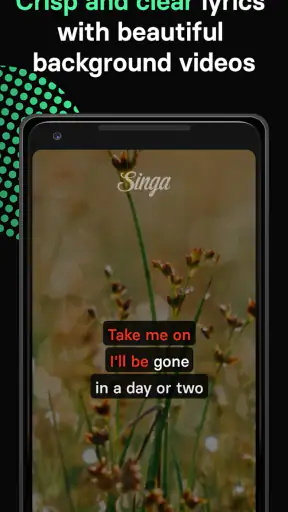
The app works best when I treat it as a personal songbook. I can look for a track based on my mood, choose something that suits my voice, and use the displayed lyrics as a guide while the instrumental arrangement plays. That sounds basic, but presentation makes a major difference. A karaoke session becomes frustrating when the words are late, hard to read, or surrounded by distracting interface elements. Singa’s purpose is clearer than that of a general music player, so the singing task stays at the center.
I would still recommend using headphones or an external speaker depending on the setting. Phone speakers are enough for checking a song or practicing quietly, but they rarely make a room feel like a performance space. If friends are listening, a larger speaker gives the backing track more presence. The app itself cannot solve the limitations of a small phone speaker, so the quality of the session depends partly on the equipment around it.
Useful for practice, not just parties
One of the less obvious strengths is that karaoke can be a low-pressure way to work on a song. I can repeat a difficult section, test whether the key feels comfortable, and decide whether I actually like singing a song before attempting it in front of other people. That makes Singa more useful than a party-only application. It can become a private rehearsal tool for someone preparing to sing at a gathering or simply trying to become more confident.
There is a practical trick here: I choose songs by vocal comfort before choosing them by popularity. A track that sounds impressive in the original recording may sit too high, move too quickly, or leave little room to breathe. Starting with songs that match my natural range produces a much better experience. Singa is especially helpful in this workflow because the app encourages me to test a song immediately rather than merely listen to it.
For casual group use, I would create a loose queue before handing the phone around. This avoids the awkward pause where every person searches from scratch while everyone else waits. It also lets the group mix familiar choices with one or two challenges. The app is more enjoyable when the social flow is planned lightly, even though the singing itself remains spontaneous.
Finding the right balance between choice and access
The large user base suggests that the concept has broad appeal: Singa has passed one million installs. Its average rating is 3.1 from roughly 2.9 thousand ratings, which tells me to approach it with realistic expectations rather than assuming every user will have a perfect experience. A score in that range does not make the app unusable, but it does suggest that song availability, account expectations, performance, or paid access may matter differently from one person to another.
The most important question for a new user is not simply whether the app is free to download. It is whether the songs I want to sing are available in the way I expect and whether I am comfortable with the paid model after the trial period. I would use the thirty-day trial to test several kinds of songs, not just one favorite. I would also try the app at the times and places where I am most likely to use it, because a service that works for occasional solo singing may feel different when a group is waiting.
That approach prevents a common mistake: judging the app after a single successful song. A good first track proves very little. I would search for older favorites, newer songs, slower material, and something outside my usual taste. If the catalogue feels useful across those searches, the subscription or purchase options become easier to evaluate. If only one narrow style works for me, a general video platform may offer better flexibility.
The meaningful limitations
My main reservation is the relationship between free access and paid content. The app is free, but in-app purchases can reach as high as eighty-nine dollars and ninety-nine cents per item. That does not mean every user will pay that amount, but it does mean I would not treat the free download as the complete product. Anyone who expects a permanently unrestricted karaoke library should examine the available access carefully before building the app into a regular routine.
This also changes how I would use the trial. I would not start it casually and forget about it. I would set aside enough time to explore the catalogue, test the singing experience, and decide whether the paid model fits my habits. A trial is most valuable when it answers a specific question: will I return to this app often enough to justify paying for continued access? If the answer is no, the free period can still be useful for a short project or a one-time event, but I would not plan around it indefinitely.
Another limitation is that karaoke quality depends on more than the app interface. A phone microphone, room noise, weak speakers, and an uncomfortable vocal range can make a song feel worse than it really is. I would avoid judging the whole service from one difficult performance. At the same time, Singa is not a replacement for a dedicated home karaoke setup when sound quality, microphones, and room-filling volume are the priority. Its strength is portability, not professional equipment.
The rating also makes me cautious about recommending it blindly. With about 136 written reviews alongside the broader rating count, there is enough public feedback to show that experiences vary. I would not interpret that as a reason to avoid the app, but I would make the trial part of the decision rather than assuming the service will suit every singer. The app is better approached as something to test personally, especially if my music preferences are specific.
Who should choose it
I think Singa is a good fit for people who want portable karaoke practice without assembling a full setup. It suits a person who sings alone at home, a small group looking for an easy activity, or a beginner who wants lyrics and backing music in one focused place. It is also useful for someone who enjoys discovering whether a song fits their voice before performing it socially.
It may be particularly appealing to users who value a dedicated karaoke environment over the uncertainty of searching general video services. Those alternatives can be convenient and broad, but they often require more filtering. Different uploads may have inconsistent lyric timing, arrangements, or audio levels. Singa’s focused purpose gives me a cleaner starting point when I want to sing rather than browse endlessly.
I would skip it, or at least test it very carefully, if I only sing once or twice a year and already have a reliable alternative. A free video platform may be enough for a one-off party, especially if I do not care about a polished catalogue experience. I would also look elsewhere if I need advanced vocal recording, detailed performance analysis, or a serious music-production workflow. Singa is about singing along, not replacing recording software or a rehearsal studio.
It is also not ideal for someone who dislikes paid access models. Even though installation costs nothing, the purchase range means the financial side deserves attention. If I want complete predictability, I would compare the total cost of regular use with other karaoke services before committing. The right choice depends less on the headline price and more on how frequently I will actually open the app.
Practical ways to get more from it
My first recommendation is to test the same song in two environments: alone with headphones and aloud through a speaker. Headphones help me focus on timing and lyrics, while a speaker reveals whether the arrangement feels comfortable at room volume. This simple comparison can show whether I need to lower the volume, change the song, or choose a quieter setting for practice.
My second recommendation is to build a personal progression rather than choosing only showpieces. I would begin with songs I know well, move to tracks with more demanding phrasing, and finish with something fun rather than technically difficult. That keeps the session from becoming a test of endurance. It also makes the app useful for gradual confidence-building instead of a sequence of random searches.
For a group, I would agree on a few basic rules before starting: keep the phone nearby, choose the next singer early, and avoid making every selection a long search. These are small details, but they prevent the app from becoming the focus of the gathering. Singa works best when the technology disappears into the activity.
I would also keep expectations realistic about lyrics. Reading words on a phone is convenient, but it is not the same as seeing a screen across a room. If several people are singing, place the device where everyone can read it or connect the sound to a larger setup while keeping the phone accessible. This is a practical limitation of mobile karaoke rather than a flaw unique to Singa, but it affects the experience immediately.
What the developer and age rating mean for the audience
Singa is developed by Singa and is marked for a Teen audience. That makes sense for a music app intended for a broad range of popular songs, but I would still use personal judgment when younger listeners are involved. A family gathering should include a quick check of song choices rather than assuming every available track suits every listener.
The app has been available since October 31, 2014, so it is not a brand-new experiment. That history helps explain why the concept feels established, but it should not be mistaken for a guarantee that every current user will have the same experience. Music catalogues, access arrangements, and personal expectations matter more to me than the app’s age. I would judge it by how well it serves my present use case.
For adults and teens who enjoy singing, the age label is unlikely to be an obstacle. The more relevant consideration is whether the user wants casual entertainment or a more technical vocal tool. Singa clearly leans toward the former, with enough usefulness for practice but without making itself feel like specialist training software.
My final recommendation
After using it as a mobile karaoke option, I see Singa as a convenient and focused way to sing without setting up a traditional system. Its strongest qualities are immediacy, portability, and the ability to turn song selection into an actual activity. I can imagine recommending it to a friend who wants a relaxed singing app for home use or a small gathering, especially if that friend is willing to test the catalogue during the free trial.
My recommendation comes with a clear condition: check the paid access before getting attached to the service. The free installation is inviting, but the in-app purchase range means regular users should decide whether the cost matches their habits. I would also compare it with general video platforms if my needs are occasional, highly specific, or centered on finding unusual songs rather than enjoying a dedicated karaoke workflow.
For me, the verdict is positive but selective. Singa is not a full replacement for microphones, speakers, or professional vocal tools, and it is not automatically the cheapest long-term route for every singer. What it does well is make karaoke available with very little preparation. If you want a convenient singing companion rather than a complete studio, it is worth trying during the thirty-day free period and judging it by the songs you actually sing.


